The idea came from frustration. I kept reading about SEO practitioners who had built real authority from expired domains — bought an aged domain for €40, redirected it, and watched rankings climb without a single new backlink. The approach works. The problem is finding domains that qualify.
I spent two weekends doing it manually. The process is almost insultingly repetitive: download an expiry list, check each domain against a backlink tool, cross-reference with the Wayback Machine to make sure the site was legitimate, verify current availability. For a list of 500 domains, that's six hours of work to surface maybe three candidates. I built Domain Radar to do that six hours in about four minutes.
What is an expired domain, and why does it matter?
When a domain owner stops renewing, the domain eventually drops back into the pool and becomes available to anyone. If that domain had real backlinks pointing to it — from actual publications, blogs, directories — those links don't disappear when the domain expires. The referring pages still exist, still link to that URL.
Pick up the domain, and you inherit the backlink profile. An aged domain with a domain rating of 30 and 40 referring domains is worth real money to an SEO campaign. A new domain registered today starts at zero.
This isn't a trick or a grey area. It's been standard practice since at least 2012. What's changed is that the number of expired domains available daily has grown enormously — CommonCrawl alone tracks hundreds of thousands of expiring domains per month — which means the signal-to-noise ratio has gotten worse, not better. Finding quality manually is harder than it used to be.
Why does manual expired domain research fall apart at scale?
Manual research has a ceiling and it's low. The workflow looks like this for every single domain:
- Check if it's actually expired or just expiring soon
- Run it through Moz or Ahrefs for domain authority and spam score
- Hit the Wayback Machine CDX API to verify real content existed
- Look at the backlink list to confirm they're from real sites
- Check auction status — is it already sold?
Each of those is a separate API call or manual check. Five steps per domain, 500 domains in a batch, one person doing it: you're looking at a full working day to produce a shortlist of maybe five candidates. Run the same numbers on 10,000 domains and it's a full working week — every week.
"The domains worth buying are gone in hours after they drop. A manual process that takes days can't compete with that."
The other problem is consistency. When you're doing this by hand and it's hour four of checking domains, your filters get loose. You start approving things that don't quite meet your own criteria because you're bored and you want to find something. Domain Radar applies the same filter logic at domain #9,847 as it does at domain #1.
How Domain Radar actually works
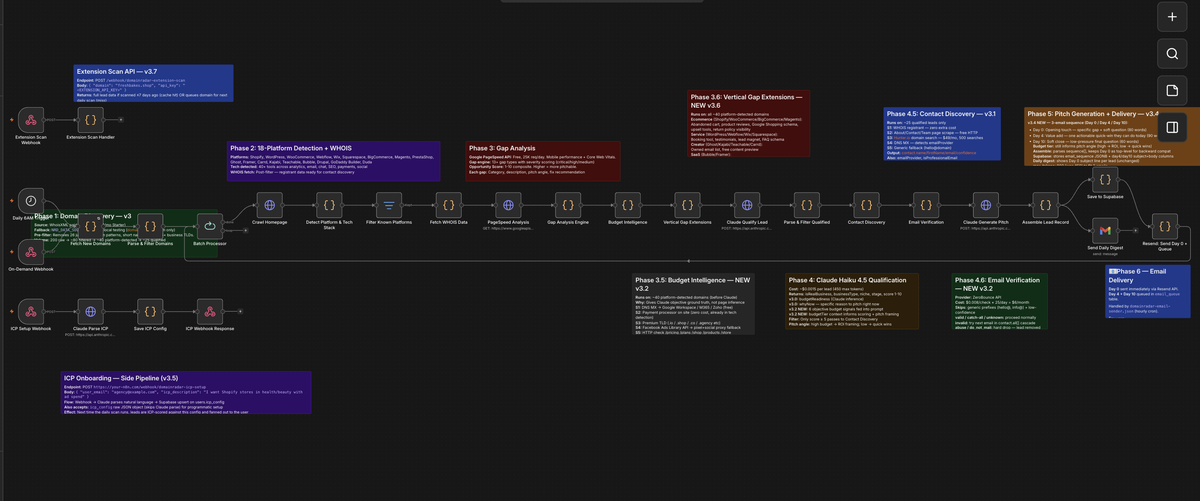
The whole pipeline runs on n8n, triggered on a schedule. Here's the sequence:
Step 1 — Pull the expiry feed
Domain Radar pulls from two sources: a domain expiry feed API that lists domains dropping in the next 7 days, and CommonCrawl's domain list for domains that recently became available. The raw input is a few thousand domains per run.
Step 2 — First filter: extension and length
TLDs matter for authority transfer. The pipeline keeps .com, .net, .org, and a handful of country-code TLDs. It drops anything with a hyphen, anything over 20 characters, and anything that looks like a random character string. This alone cuts the list by around 60%.
Step 3 — Spam score check
The remaining domains get checked against the Moz API for spam score. Anything scoring above 5 is out. This catches link farms, PBN casualties, and domains that were previously used for spam campaigns. Roughly 25% of domains that make it past step 2 fail here.
Step 4 — Wayback Machine verification
This is the one that matters most. The Wayback Machine CDX API returns a snapshot history for any domain — how many times it was archived, and when. A domain with zero Wayback snapshots before 2020 is a red flag. A domain with a consistent crawl history going back five years almost certainly had real content and real traffic. Domain Radar requires at least 10 archived snapshots before 2022.
A domain can have backlinks from real sites without ever having real content itself. Some expired domains were registered speculatively or bought by link sellers who pointed backlinks at them to inflate their metrics. The Wayback check is the fastest way to separate genuine sites from artificially inflated ones.
Step 5 — Domain authority threshold
After Wayback verification, the remaining domains get a domain authority check. The threshold is DR 20 or higher, with at least 15 referring domains. Below that, the domain isn't worth the registration cost plus the time to integrate it into a strategy.
Step 6 — Availability confirmation and output
The final check is availability. Domains that pass all five filters get their current registration status confirmed via a WHOIS API. Anything already snapped up gets dropped. What remains goes into an Airtable base with the full data snapshot: DR, spam score, referring domain count, earliest Wayback date, and current availability status.
What did checking 10,000 domains actually teach me?
A few things I didn't expect.
The pass rate is lower than I thought. Of 10,000 domains checked in a typical weekly run, around 15-20 make it through every filter. That's 0.2%. Before building Domain Radar, I would have guessed 2-3%. The spam and Wayback filters are much more aggressive than I expected them to be — most expired domains with decent backlink metrics have either been through a spam campaign or were artificially inflated at some point.
Country-code TLDs outperform their reputation. .co.uk, .de, .fr, .io domains that pass the spam check tend to have cleaner backlink profiles than .com equivalents at the same DR range. I'm not sure why. My best guess is that country-code domains attract fewer link builders targeting English-language audiences, so they stay cleaner for longer.
| Filter stage | Domains remaining | Drop rate |
|---|---|---|
| Raw input | 10,000 | — |
| Extension + length filter | 3,800 | 62% |
| Spam score ≤ 5 | 1,100 | 71% |
| Wayback Machine (10+ snapshots) | 280 | 75% |
| Domain authority DR ≥ 20 | 60 | 79% |
| Availability confirmed | 15–20 | 67% |
The Wayback filter is the hardest gate. 75% of domains that pass spam scoring fail the Wayback check. Which means that if I had just been filtering by spam score and DR — the two checks most manual researchers stop at — I'd have been looking at 1,100 domains a week instead of 15. Nearly all of them would have been junk.
The three signals that actually predict whether a domain is worth buying
After running this for several months, three signals have proven most predictive. Not DR. Not referring domain count. These:
Age of the oldest Wayback snapshot. Domains with archives going back to before 2015 have dramatically better backlink profiles than newer domains at the same DR. Older sites accumulated links organically. Newer ones got their links built.
Niche specificity. When the domain has a clear topical focus — all the archived pages are about cooking, or software development, or automotive repair — the backlinks tend to be from real sources in that niche. Generalist domains with no clear topic tend to have link profiles built for SEO, not for readers.
Spread of referring domains over time. A domain that gained 40 referring domains between 2014 and 2020 is worth more than one that gained 40 referring domains in a six-month window in 2023. Organic link acquisition is slow. Fast accumulation in a short window almost always indicates a campaign.
What's next for Domain Radar
The pipeline works. I'm running it weekly and the output quality has been consistent. A few things on the roadmap:
Adding niche classification. Right now the output is a raw list — the buyer has to look at the Wayback snapshots to understand what the domain was about. I want to add a step that pulls the archived content and classifies the domain's niche automatically, so the shortlist comes pre-tagged.
Auction integration. Some of the best expired domains get caught in auction platforms before they hit the open drop. Building a connection to GoDaddy Auctions and Sedo to track domains entering auction would capture those opportunities before they're gone.
If you're doing SEO at any scale and not looking at expired domains, you're leaving a real acquisition channel untouched. The barrier has always been the research. Domain Radar is an attempt to remove that.
For context on the other tools I've built with the same automation approach: PitchEdge does per-investor intelligence for founders raising capital, and Harit is a premium microgreens brand I built solo — from brand identity to a live, indexed site.